
Vibe Coding for Legacy Software Frontends: How AI Modernizes Interfaces Without Rewriting Everything
Thousands of companies use ERPs, management systems and CRMs every day with interfaces from the 2000s. Rewriting them costs millions. Vibe Coding with AI lets you build a modern frontend on top of the existing software in weeks.
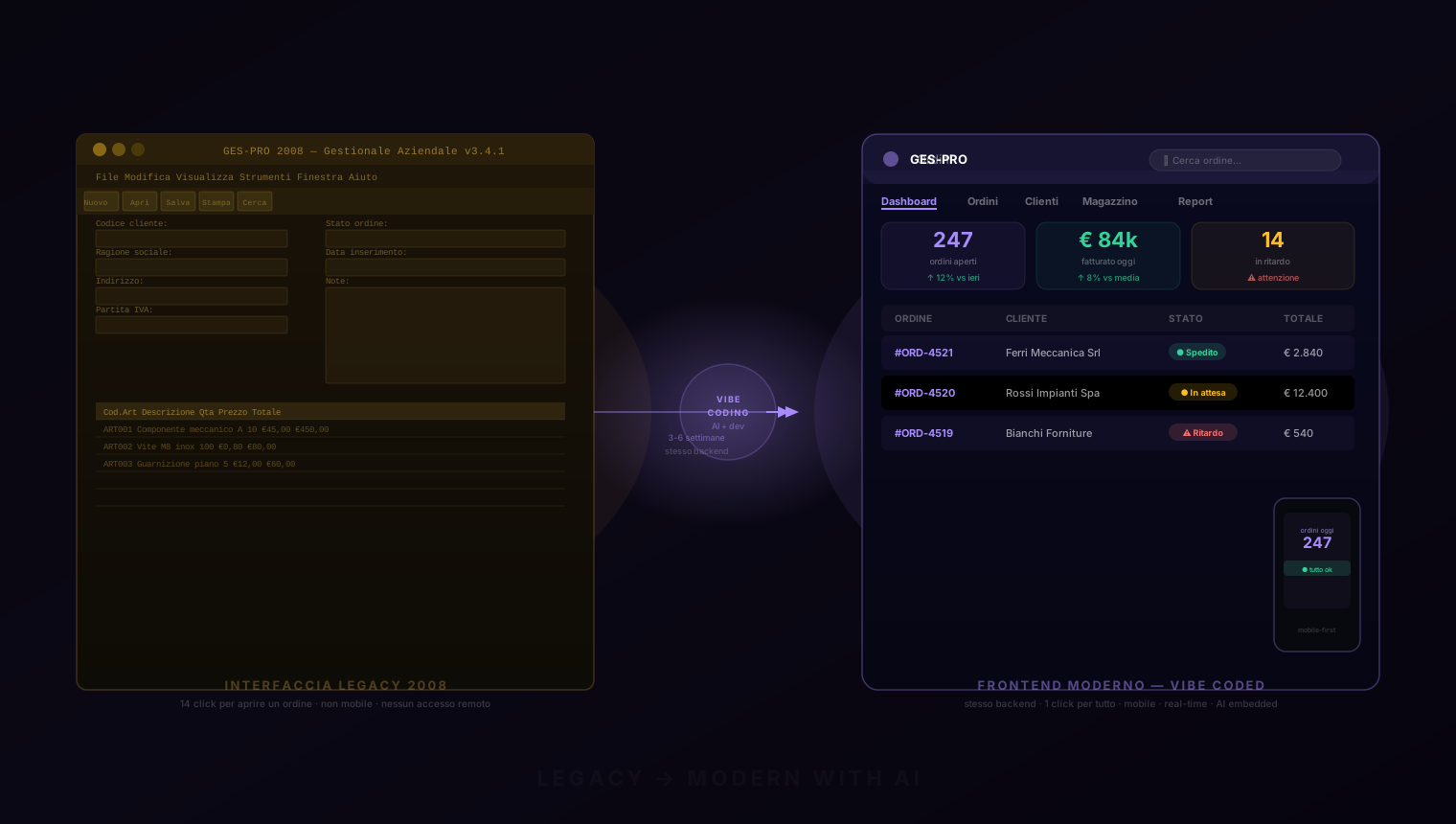
There is a problem almost every Italian company knows well but few admit publicly: the software that runs the core of the business — the ERP, the management system, the CRM, the production system — has interfaces that look like they came out of 2005. They work. But they are slow, unintuitive, impossible to use on mobile, and every time a new employee is onboarded you need three hours of training just to navigate the menus.
The obvious solution would be to rewrite everything. But rewriting a company ERP costs from hundreds of thousands to millions of euros, takes years, and carries a huge operational risk — because that legacy software, however ugly, knows perfectly all the business processes, the exceptions, the unwritten rules accumulated over twenty years.
You do not need to rewrite the software. You need to build a better frontend on top of what already works.
What Vibe Coding is and why it changes the game
Vibe Coding is an approach that emerged in 2025 in which the developer — or even a non-developer — describes to an AI model what they want to build, and the AI generates the code. It is not just autocomplete: it is complete generation of components, pages, navigation flows, API calls. Tools such as Cursor, Bolt, Lovable and Claude Artifacts have made this approach viable for real projects.
Applied to the legacy software problem, Vibe Coding opens a concrete path: building a new frontend layer — modern, mobile-first, intuitive — that talks to the existing backend through APIs or screen scraping, without touching the original software.
The legacy software problem: a typical case
Imagine a manufacturing company with a management system installed in 2008. The software works: it handles orders, warehouse, invoicing, production. But the interface takes 14 clicks to open an order, does not work on tablets, production managers have to go back to their desks to check the status of jobs, and every report must be exported to Excel and reworked by hand.
Rewriting this system is out of the question. But building a modern web app on top of it — with a clean interface for each business role — is a project of weeks, not years.
How it works in practice: the three architectures
There are three main approaches to building a modern frontend on legacy software, and the choice depends on how “open” the original software is.
- API layer: if the software exposes APIs (REST, SOAP, an accessible database), the new frontend calls them directly. It is the cleanest and fastest case. The AI generates the React or Vue components that call those APIs and render the data in a modern way.
- Intelligent screen scraping: if the software has no APIs but has a web or desktop interface, an automation layer (Playwright, Puppeteer, RPA) extracts the data in real time and passes it to the new frontend. Less elegant but effective.
- Database read layer: if you have direct access to the database, you build a read layer (with read-only access for safety) and the new frontend queries that. Writes continue to happen in the original software.
The role of AI in the process: how Vibe Coding is used
With a Vibe Coding approach, the workflow changes radically. Instead of a team of developers writing code for months, you work like this:
- You define with the business the flow you want to modernize — for example order management for the production manager.
- You map the data: where it lives, how to retrieve it, what the new frontend must show.
- You describe to the AI the component you want to build: 'a mobile-first screen showing the day's orders with status, quantity and assigned department, with an urgency filter'.
- The AI generates the code. The developer (or the company's technician) adapts, tests and iterates.
- In a few days you have a working prototype. In a few weeks, an interface in production.
What used to take 6 months of traditional development is now done in 3-6 weeks. Vibe Coding does not remove the need for technical expertise — you still need people who understand architecture, security and integration — but it drastically cuts time and costs.
What you can build: concrete examples
- Operational dashboard for production managers: real-time job status, delay alerts, quick access to orders — on a tablet, without opening the management system.
- Mobile app for sales agents: browsing price lists, stock, customer history and entering orders from the phone — synchronized with the legacy CRM.
- Customer self-service portal: customers see their own orders, invoices and shipment status without calling the office — the data comes from the existing management system.
- Role-based interface by department: each business function (purchasing, logistics, administration) gets its own simplified view of the data it really needs.
- Automated reports: instead of manual Excel exports, a frontend that generates reports in the right format, updated in real time.
The limits to know before starting
Vibe Coding for legacy is not a magic wand. There are real constraints to consider. If the legacy software has no APIs and is not accessible via web, the integration layer becomes complex. If the database is opaque or poorly documented, mapping the data takes time. And the new frontend, however beautiful, does not solve the process problems that live in the original software — it only makes it more usable.
The right starting point is always a POC on a single flow: choose the most painful process, build the frontend for it, validate it with real users, and then expand. This approach reduces risk, produces fast results and builds internal consensus on the project.
The business case: what justifies the investment
The economic calculation is straightforward. A Vibe Coding project to modernize a legacy interface costs between 15,000 and 60,000 euros depending on complexity — against 300,000-1,000,000+ for a complete rewrite. Timelines are 4-8 weeks against 18-36 months. Operational risk is minimal because the original software stays intact.
On the benefits side: shorter onboarding time for new employees, elimination of errors caused by confusing interfaces, mobile access to business data, fewer IT requests for reports and lookups. In many cases ROI is reached within the first 6-12 months.
You do not have to choose between keeping the legacy software and having a modern interface. You can have both.
How TeraBrain approaches the problem
TeraBrain uses Vibe Coding integrated with AI Agents to build modern frontends on legacy business software. Not just the graphical interface: the new frontends can include embedded AI agents that help the user — suggesting actions, retrieving information, filling in fields automatically, warning about anomalies.
The result is an interface that is not only nicer, but smarter: it understands the user's context, accesses the right data at the right time and reduces the cognitive load on those who use it every day.
If your company has legacy software holding back productivity, contact us for a POC: in two weeks we build a working prototype on your most critical flow.