
Open Source and In-House LLMs: When It Makes Sense to Keep the AI Model Inside Your Company
Sending your company data to OpenAI or Google is not always the right choice. For many Italian SMEs, a self-hosted open source LLM offers more control, lower costs and no GDPR headaches. Here is when it makes sense and how it is done.
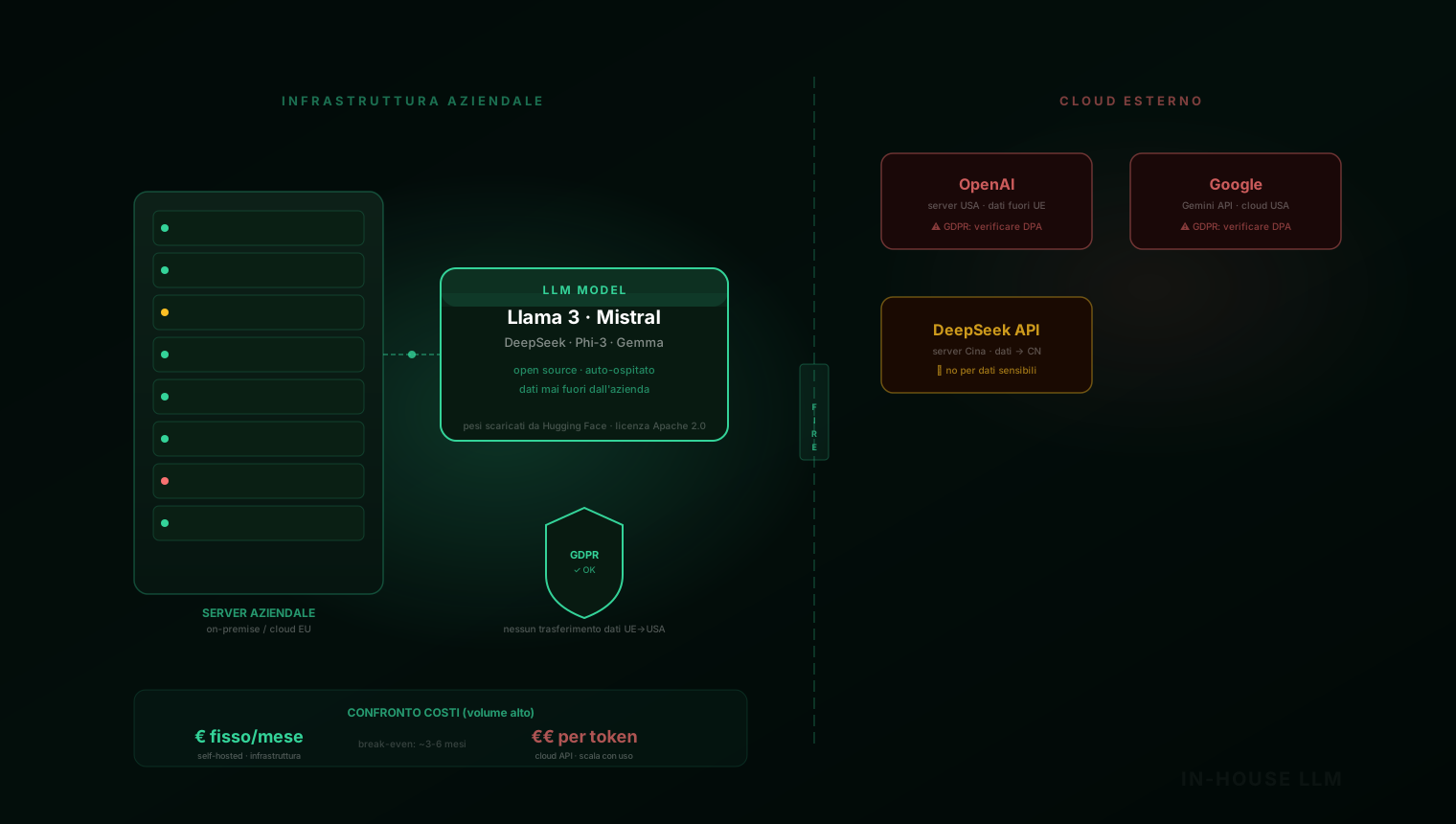
Every time your company uses GPT-4, Claude or Gemini through an API, the data you send is processed on servers owned by OpenAI, Anthropic or Google — American companies, subject to US law, with data centers that may be outside the European Union. For many Italian companies this is not a problem. For others, it is a real obstacle.
Contracts with customers that forbid sharing data with third parties. Healthcare, legal or financial data covered by specific regulations. Trade secrets or proprietary processes that you do not want leaving the company. In these contexts, using an LLM through an external cloud creates a compliance risk the board cannot ignore.
The question is not whether cloud models are secure. The question is whether your compliance allows you to use them.
What open source LLM means
An open source model is an LLM whose weights — the parameters learned during training — are publicly available and downloadable. This means you can install it on a server you own, in a private cloud or in a European data center, and run it completely under your control. The data never leaves your infrastructure.
The main open source models available today are Meta's Llama 3, Mistral and Mixtral (a French, therefore European, company), DeepSeek R1 and V3, Alibaba's Qwen, Microsoft's Phi-3 and Google's Gemma. The performance of the best open source models in 2025 is competitive with GPT-3.5 and approaches GPT-4 on specific tasks — especially if you use versions fine-tuned for the company's domain.
The real advantages of an in-house LLM
Data control is the most cited advantage, but it is not the only one. There are at least four other reasons why a self-hosted LLM can be the right choice for an Italian SME.
- Predictable cost: with a cloud model you pay per token — every API call has a variable cost that scales with use. With a self-hosted model you pay for infrastructure (servers or cloud GPUs), a fixed cost independent of request volume. For companies with a high volume of repetitive tasks, break-even often arrives within 3-6 months.
- No network latency: the model answers from your infrastructure, without round-trips to American servers. For real-time applications or voice bots, this means faster responses.
- Domain fine-tuning: you can train the model on your company data — internal procedures, industry terminology, proprietary documents — without sharing anything with anyone. The result is a model that knows your business as no generic model can.
- Vendor independence: no risk of price changes, service interruptions or changes to usage policies by the provider.
The limits nobody tells you about
A self-hosted LLM is not free. It requires adequate hardware — typically NVIDIA GPUs with at least 24GB of VRAM for medium models, or GPU clusters for large models. It requires technical expertise for installation, maintenance and updates. And it requires a team that knows how to integrate it into business applications.
For an SME without a structured IT team, managing an in-house LLM can be more complex than the benefit it brings. The most sensible middle solution in these cases is a European private cloud: the model runs on cloud infrastructure (AWS Frankfurt, Azure Netherlands, Google Belgium) without ever leaving the EU, with simplified management and GDPR compliance.
The GDPR picture: what the regulation really says
The GDPR does not forbid using American LLMs. It forbids transferring personal data outside the EU without adequate safeguards. OpenAI, Google and Anthropic all offer options with European data residency and GDPR-compliant DPAs (Data Processing Agreements). The concrete question is not 'can I use GPT?' but 'have I checked that the contract includes the standard contractual clauses for data transfer, that the data is processed in the EU and that it is not used for training?'
For particularly sensitive data — health data, judicial data, classified trade secrets — the safest solution from a legal standpoint remains self-hosting or a European private cloud, regardless of the contractual guarantees offered by American vendors.
Which open source model to choose
The choice depends on model size (and therefore the hardware needed), language and application domain.
- Llama 3 70B (Meta): the reference point for general quality. It requires significant hardware but offers performance close to GPT-3.5 on Italian tasks. Permissive commercial license.
- Mistral 7B and Mixtral 8x7B (France): great quality/size ratio, good Italian, fully free Apache 2.0 license. The ideal choice for European companies attentive to provenance.
- Distilled DeepSeek R1: compact versions (7B, 14B) with reasoning capabilities beyond their size. Low hardware cost.
- Phi-3 Mini (Microsoft): a very compact model (3.8B parameters) that runs even on modest hardware. Ideal for simple tasks on machines with consumer GPUs.
- Gemma 2 (Google): open source, good performance on Italian tasks, excellent documentation.
The hybrid approach: the best of both worlds
Most Italian companies implementing AI maturely do not choose between cloud and self-hosting — they use both. The hybrid architecture works like this: sensitive data and critical tasks are processed by the in-house model, while generic, low-sensitivity tasks are sent to the most suitable cloud model.
This requires an orchestration layer that can classify each request and route it to the correct model automatically. It is not a theoretical concept — it is exactly how the most advanced business implementations work in 2025.
- Customer data and contracts → self-hosted model in a European cloud
- Analysis of public texts and research → GPT-4o or Claude via API
- High-volume classification → local open source model, almost zero cost
- Complex reasoning and decision-making → premium long-context model
How to start: the practical path
The starting point is not choosing the model — it is mapping your data. What information are you planning to send to the LLM? Is it customers' personal data? Financial data? Trade secrets? Or is it generic text, public FAQs, non-sensitive documentation?
From this mapping it emerges naturally what percentage of your use cases can go to an external cloud and what requires an in-house approach. For most Italian SMEs the answer is that 70-80% of tasks can go to the cloud with the proper contractual guarantees, and 20-30% require more attention.
TeraBrain supports both architectures: cloud models (OpenAI, Claude, Gemini) and self-hosted open source models, with automatic routing based on security policies configurable for each agent and each type of data. If you want to understand which architecture is right for your company, the first step is an assessment call — no commitment, no sales pitch.