GPT, Claude, Gemini, DeepSeek, Grok, Qwen: Which LLM to Choose for Your Company
There is no single best LLM. There is the right model for each process. A practical guide for managers and IT teams choosing between GPT-4o, Claude, Gemini, DeepSeek, Grok and Qwen.
In 2025 the number of LLM models available to companies exploded. OpenAI's GPT-4o, Anthropic's Claude, Google's Gemini, DeepSeek from China, xAI's Grok, Alibaba's Qwen, Meta's Llama. Every week a benchmark comes out declaring a new winner. And every week the CTO on duty has to answer the same question from the board: which one do we use?
The honest answer is: it depends on what you need to do. There is no absolute best LLM for companies, just as there is no absolute best management software. There are models with different characteristics, optimized for different tasks, with different implications for cost, privacy, speed and reliability.
Choosing a single LLM for the whole company is like choosing a single tool for the whole production line. It works, but it is not optimal.
GPT-4o and GPT-4 Turbo (OpenAI)
GPT-4o remains the most versatile and most tested model in business contexts. It has the advantage of a mature ecosystem: plugins, stable APIs, integration with Microsoft 365 Copilot, extensive documentation. It is the right model for complex tasks that require deep reasoning: legal analysis, contract drafting, summarizing long documents, decision support.
The main limit is cost: among the highest on the market per token. And privacy: data sent to OpenAI leaves Europe, which raises GDPR questions for sensitive data. With Microsoft Azure OpenAI the data residency issue can be solved, but it adds architectural complexity.
- Great for: document analysis, drafting, legal and compliance support, complex tasks.
- Watch out for: high cost per token, data leaving the EU without Azure.
- Business integration: excellent via Microsoft 365, the OpenAI API, ChatGPT Enterprise.
Claude 3.5 and Claude 4 (Anthropic)
Anthropic's Claude is the model that gained the most ground in 2025 among teams working on long, complex texts. It has the longest context window among the main models (200K tokens), which makes it ideal for analyzing contracts, annual reports, company knowledge bases or extensive technical documentation.
Claude's distinctive feature is its focus on safety and on reducing hallucinations in professional contexts. Anthropic has invested heavily in what it calls 'constitutional AI' — the idea that the model should be guided by explicit principles, not just by training data. The practical result is a more cautious, more predictable model, less prone to inventing facts.
- Great for: long-document analysis, customer care, tasks requiring precision and consistency.
- Watch out for: fewer native integrations than OpenAI, stricter API rate limits.
- Business integration: via the Anthropic API or AWS Bedrock for those on Amazon infrastructure.
Gemini 1.5 Pro and Gemini 2.0 (Google)
Gemini is Google's model and has the most obvious competitive advantage: native integration with Google Workspace. If your company uses Gmail, Drive, Docs, Sheets and Meet, Gemini is already inside your tools through Google Workspace AI. For Google-first companies, it is often the most immediate choice without changing anything in the infrastructure.
Gemini 1.5 Pro also has one of the longest context windows on the market and competitive performance on multimodal tasks — analyzing images, charts, slides. Where it is still behind GPT-4 and Claude is complex reasoning in Italian: its performance in languages other than English keeps improving but is not yet at the level of its competitors.
- Great for: Google Workspace companies, multimodal tasks, analysis of images and visual documents.
- Watch out for: Italian quality below competitors on complex tasks.
- Business integration: Google Workspace, Vertex AI for developers.
DeepSeek R1 and V3 (China)
DeepSeek shook the market in early 2025 with performance close to GPT-4 at a fraction of the cost. The R1 model, optimized for reasoning, achieved benchmarks competitive with the best Western models despite being trained with far fewer resources. The reason for business interest is simple: the cost per token is among the lowest available.
The delicate issue is provenance. DeepSeek is a Chinese company and its models, if used through the official APIs, send data to servers in China. For sensitive, strategic or GDPR-covered data, this is a real problem. The solution is to use DeepSeek as a self-hosted open source model — available on Hugging Face — completely removing the dependence on Chinese infrastructure.
- Great for: high-volume, low-risk tasks, contexts where cost is decisive.
- Watch out for: data going to China via the official APIs — use only the self-hosted version for company data.
- Business integration: self-hosting on your own infrastructure or European cloud.
Grok (Elon Musk's xAI) and Perplexity
Grok is the model from xAI, Elon Musk's company. It has native access to the real-time data stream of X (formerly Twitter), which makes it interesting for sentiment analysis, reputation monitoring and trend research. For general business use cases it is still less mature than its competitors, with a less stable API and a limited integration ecosystem.
Perplexity is not an LLM in the traditional sense — it is an AI search engine that uses LLMs to answer with verifiable citations. It is useful in research and intelligence contexts, not as the engine of a business agent. It should not be compared with GPT or Claude for process automation.
Qwen (Alibaba) and Chinese open source models
Alibaba's Qwen is the other major Chinese model that gained attention in 2025. Like DeepSeek, it has competitive performance at far lower costs than Western models and is available as open source. Qwen's strength is quality in Asian languages and some specializations in code and mathematical reasoning tasks.
For Italian companies, Qwen is interesting mainly as a self-hosted option to cut costs on high-volume tasks where Italian quality is not critical — for example processing structured data, classification, entity extraction from technical texts.
The real competitive advantage: use them all
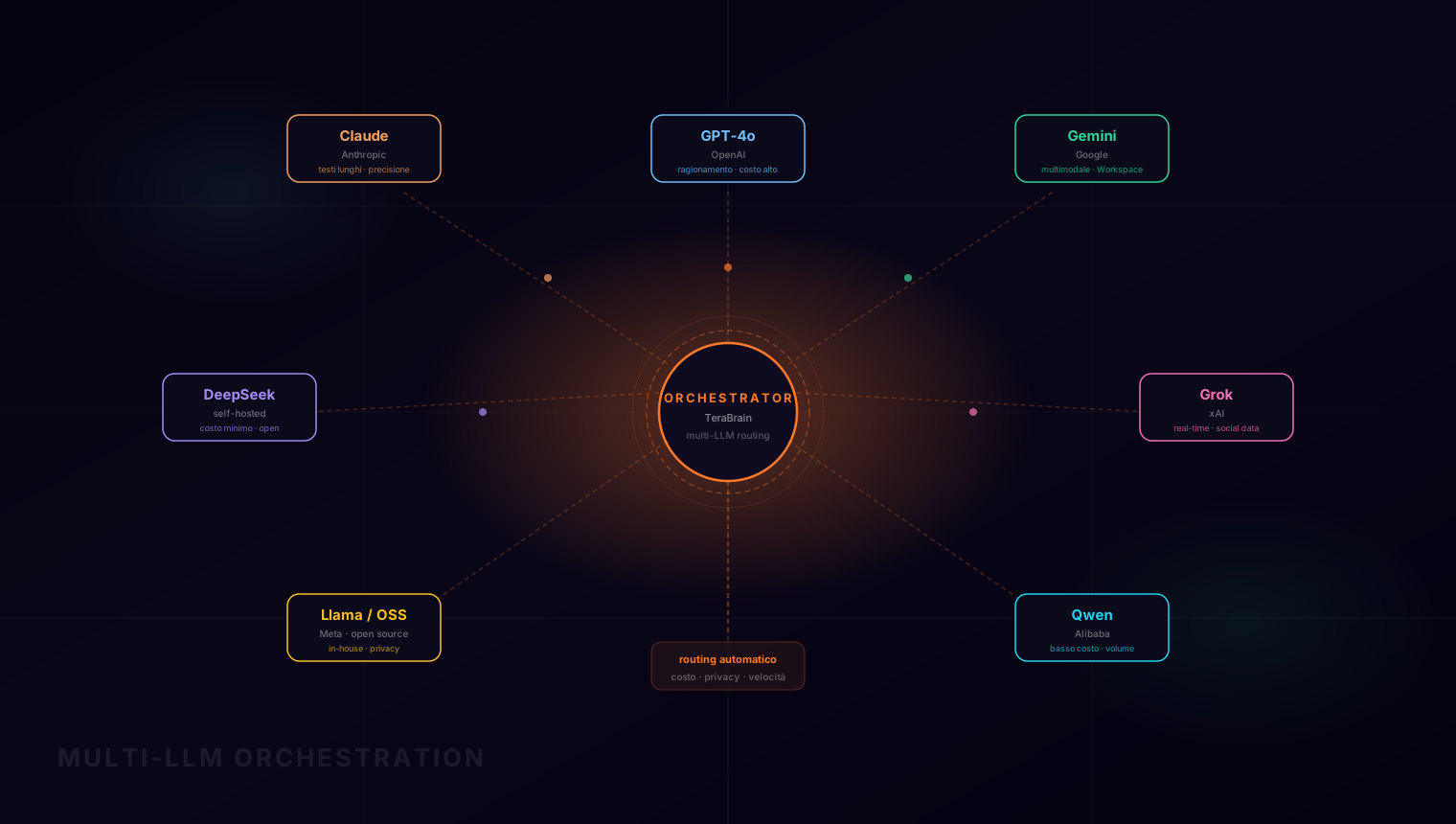
The practical conclusion is not to pick one and abandon the others. The companies getting the best results with AI in 2025 use multi-LLM architectures: the right model for each task, with automatic routing based on cost, speed, required quality and data sensitivity.
In practice this means: Claude to analyze long contracts, GPT-4o for complex decision support, a self-hosted open source model for high-volume classification, Gemini for those working in Google Workspace. It is not useless complexity — it is real optimization of cost and quality.
- Routing by cost: simple tasks on cheap models, critical tasks on premium models.
- Routing by privacy: sensitive data only on self-hosted or European-cloud models.
- Routing by specialization: each model where it truly excels.
- Automatic fallback: if a model is down or slow, the system moves to the next without interruption.
TeraBrain implements exactly this architecture: the agentic platform supports OpenAI, Claude, Gemini, open source and vertical models with automatic routing and fallback. The result is that each agent uses the model best suited to its task, without the business having to worry about the technical choice.
If you are evaluating which LLM to adopt for your business processes, the first step is not choosing the model — it is defining the use cases. From there, the choice of model becomes a natural consequence of the architecture.