
AI Co-Worker or Agentic AI Platform? The Difference Management Needs to Understand
AI Co-Work tools boost individual productivity, but governing business processes requires agents, rules, roles, integrations and control.
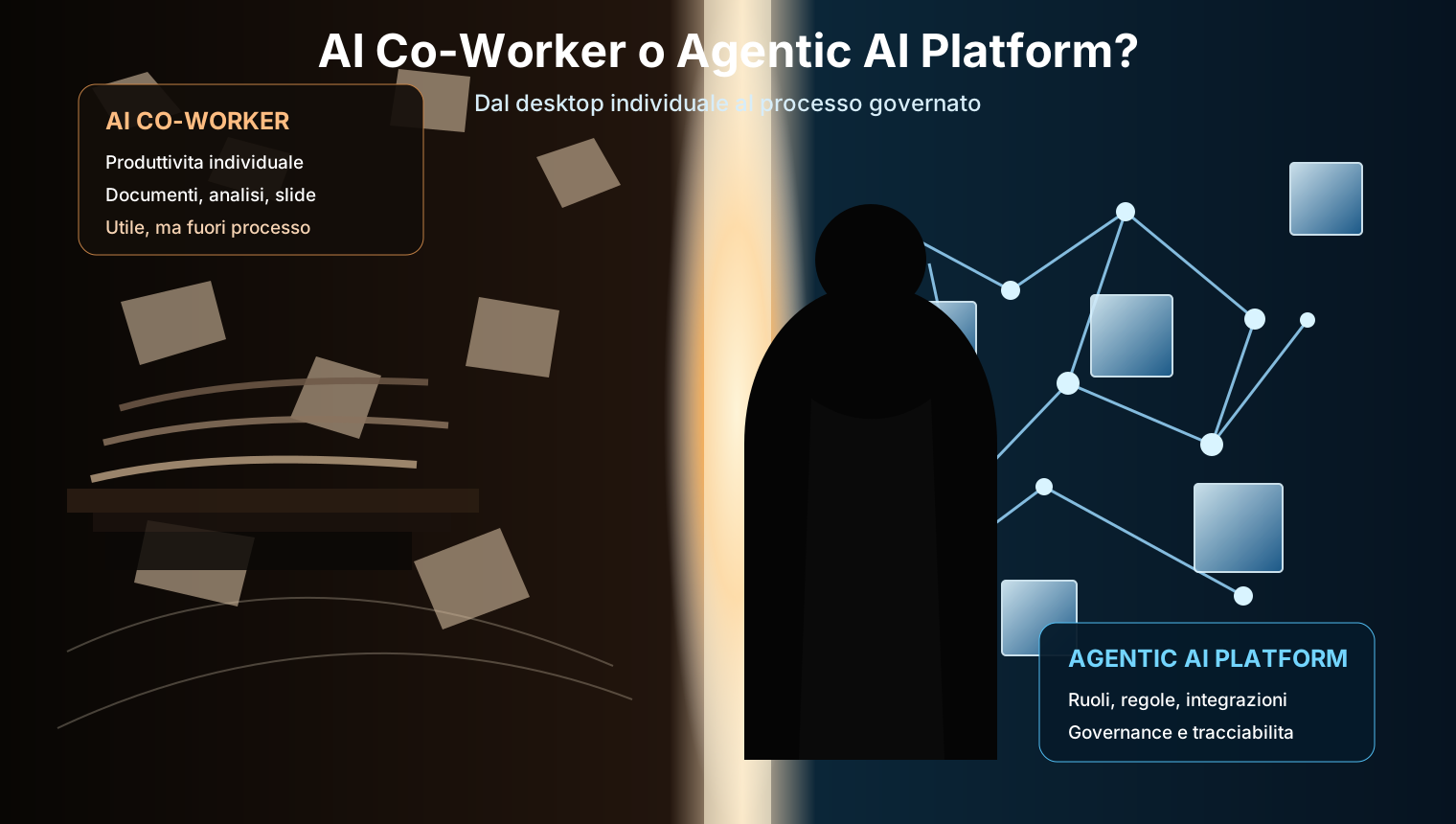
AI Co-Work tools are changing individual productivity. But managing business processes requires a different level: agents, rules, roles, integrations and governance.
In recent months a new category of tools has been spreading: AI Co-Workers. Assistants able to write texts, summarize documents, prepare analyses, build presentations, organize files, find insights in your own documents and support many daily activities.
For those who work in a company, the change is obvious. Many activities that used to require Word, Excel, PowerPoint, manual research and hours of rework can now be sped up or planned with ChatGPT, Claude or other similar tools.
This is an important step. But it must not be confused with another, much deeper one.
Using an AI Co-Worker does not mean having introduced AI into business processes.
In most cases it means having boosted individual productivity. It is a decisive difference. An AI Co-Worker helps a person produce better and faster. An AI agent platform helps an organization make a process work better.
In the first case the AI stays close to the user:
- It writes.
- It summarizes.
- It proposes.
- It organizes.
- It analyzes.
- It prepares materials.
In the second case the AI enters the company's operations:
- It accesses data and applications.
- It carries out recurring activities.
- It follows defined rules.
- It passes information between systems.
- It handles exceptions.
- It produces traceable actions.
- It works within roles and responsibilities.
- It allows monitoring and control over time.
The first misunderstanding: individual productivity is not process transformation
This distinction will be central in the coming months. Many companies risk stopping at the first level, thinking they have already made the leap. They introduce AI Co-Work tools, see individual productivity rise and conclude they have transformed their processes.
This misunderstanding is also fed by the hype of many AI Co-Work vendors. The commercial message is often simple: more speed, more productivity, less complexity.
But a process is a set of decisions, data, responsibilities, authorizations, exceptions, controls, and handovers between people and systems. And above all it has consequences.
Three risks many companies are underestimating
The first risk is creating pockets of processing. Teams, functions or individual professionals start using AI tools on their own, producing local analyses, documents and automations that remain outside any shared governance.
The result is a silent fragmentation: many solutions that are useful in the short term, but hard to integrate, control and evolve.
The second risk is confusing AI competence with the ability to integrate into the business. Knowing models, prompts and tools well is important, but not enough. Building an effective AI prototype is one thing; placing agents inside a real business environment is another.
When AI enters processes, you need architecture, integration with existing systems, security, access management, data quality, logs, monitoring, compliance and operational continuity.
This is where a broader competence becomes decisive: connecting technology, processes, applications and business infrastructure. Without it, the risk is creating interesting AI solutions that are hard to govern and operationally fragile.
The third risk is taking time away from the organization's strategic people. Managers, senior professionals and function heads start spending many hours understanding, trying, comparing and implementing new AI Co-Work tools.
They do it because these tools seem simple, immediate and within everyone's reach. But precisely this apparent simplicity can become a trap.
People who should be focused on decisions, customers, processes and strategic priorities end up venturing alone into a world that changes every week, taking precious time away from their main activities.
The problem is not experimenting. The problem is doing it without a common direction, without evaluation criteria and without a platform that turns individual learning into organizational capability.
The enterprise foundation is process security
In a company the foundation must be process security: knowing what an agent can do, what it cannot do, which data it can see, which actions it can perform and how to intervene when something does not work.
That is why an enterprise vision is needed. Not just technological curiosity. Not just prototypes. Not just effective demos.
You need a design built for security, reliability, scalability, integration and control.
The point is not to have a more powerful model or a more convenient chat. The point is to define how agents work inside the organization:
- What roles they have.
- What data they can use.
- What systems they can reach.
- What actions they can perform.
- When they must ask for confirmation.
- How they are monitored.
- How they are evaluated.
- How to reconstruct what they did.
And this is exactly where many organizations will have to change perspective. The question will no longer be: “Which AI tool do we give employees?”
But: “Which processes do we want to make more intelligent, measurable and controllable through AI agents?”
And again: “Which architecture lets us do it without losing control over data, decisions and responsibilities?”
AI Co-Workers will remain important. They will probably be the new Office: a daily layer of personal productivity, spread across every business function. But truly transforming an organization takes something else.
It takes bringing AI from the desktop to the process. From content generation to governed execution. From individual chat to the orchestration of agents. From output to accountability.
From adopting a platform to governing an agentic ecosystem
Another point will be decisive: the future of agentic AI in business will probably not be a single closed platform, chosen once and for all.
Companies will start to hire AI Agents: specialized agents, also coming from different platforms, which will have to collaborate with each other inside the same business ecosystem.
There will be agents for customer care, marketing, administration, reporting, CRM, ERP, voice, documents, training, data analysis and executive support. Some will be developed in-house, others supplied by partners, others still integrated directly into software already in the company.
In this scenario, the problem will not be having many agents. The problem will be governing them.
That is why an Agentic AI platform should not be seen only as a container of agents, but as a layer of orchestration and governance: an infrastructure able to make different agents collaborate, even ones from different ecosystems, while keeping control over data, responsibilities, processes, traceability and results.
Linegon srl has been working for years on TeraBrain, an Agentic AI Platform designed to bring AI into business processes, back when people mostly talked about models, chats and prompts, and not about operational agents.
TeraBrain's value is exactly here: turning AI from an individual productivity tool into organizational infrastructure, where AI Agents operate with roles, rules, integrations, traceability and supervision.
If you want to dig deeper into the difference between AI Co-Workers and Agentic AI platforms, we can show you concretely what changes when AI stops being just a personal tool and becomes part of business processes, through operational agents, roles, rules, integrations and governance.