
How I Built an Agentic Office That Works With Me Every Day
From the single bot to a real digital office: roles, responsibilities, orchestration and specialized AI Agents working on processes every day.
For a long time the market has described AI Agents as a simple evolution of chatbots. Smarter, faster, better at conversation, more natural in language. But looking at what is really happening inside companies, I have become convinced that this definition is no longer enough.
Agents are not just getting better: they have started to work.
I did not stop at activating an AI Assistant. I was not looking for a slightly more sophisticated chatbot to ask questions to.
I built myself a real agentic office.
A digital office that works with me every day and that I organized the way I would organize a real structure, made of people, roles, responsibilities, front office, back office, operational support and central coordination.
A central hub and two operating teams
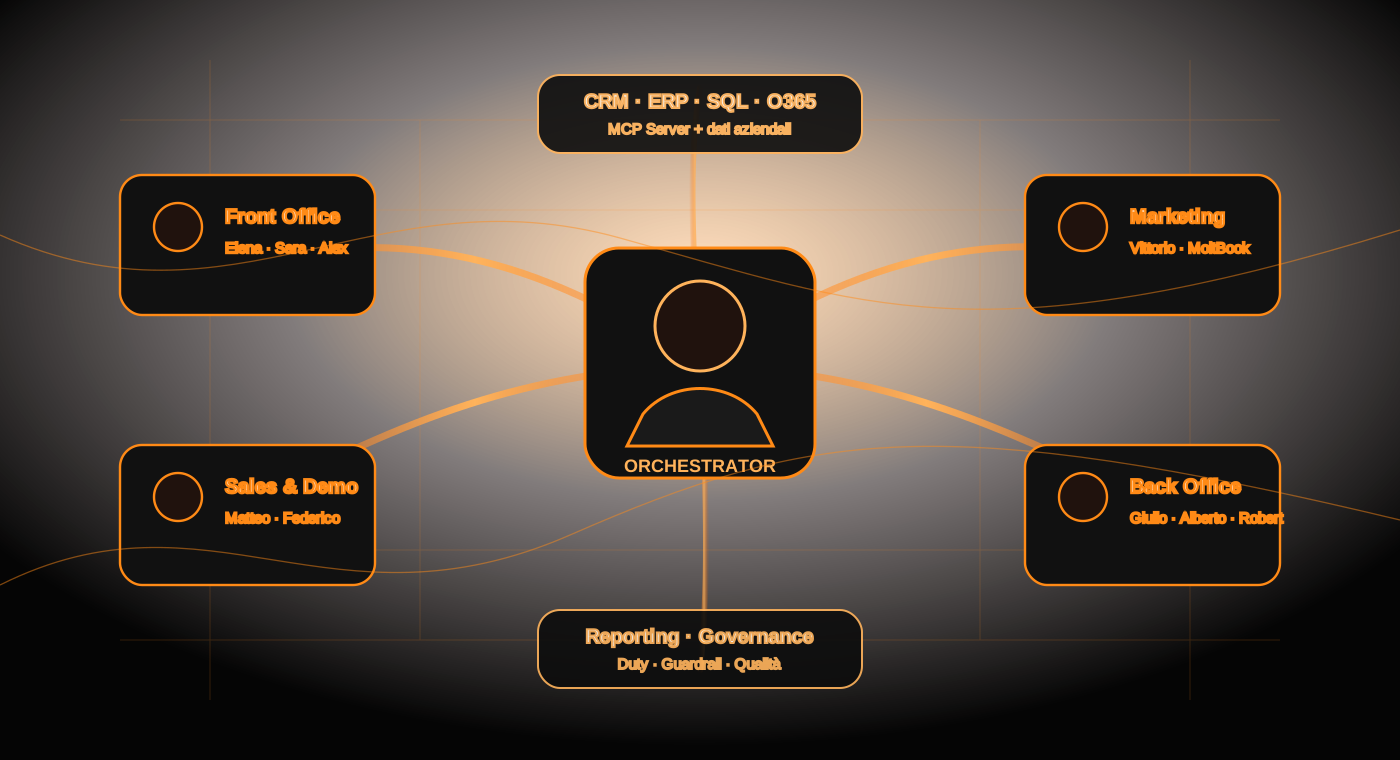
In my case there is a central hub, Bellorio Executive Orchestrator, which is the coordination center of the system. Two distinct teams work around this hub.
The first is made up of eight operational AI Agents, that is, agents that cover the most visible activities, closest to everyday business: relationship, customer care, appointments, marketing, sales, training, process analysis and advanced research.
The second is made up of nine support AI Agents, which work behind the scenes on reporting, analysis, document control, optimization, social content and connections with systems such as CRM and ERP.
In other words, I did not build a bot. I built an organized ecosystem. This is the first change of mindset companies must make.
AI Agents should no longer be thought of as undifferentiated tools. They should be thought of as digital people who join an organization to do a specific job.
The front line: agents close to the business
If I look at my agentic office, the logic is evident:
- Elena V.Bellorio Assistant is not a generic voice that answers: she covers the front office, books appointments, handles initial customer care, acts as the central assistant, classifies and files documents according to precise criteria and follows first-level customer care.
- Sara TeleMarketing focuses on outbound and telemarketing: she starts contact, opens conversations and helps with sales qualification.
- Matteo Sales Manager steps in as speaker in on-site demos, at events, trade shows and customer meetings; he helps with sales strategy and checks the status of negotiations.
- Alex Sales Account covers remote demos and product presentations by phone, presents offers, plans activities and account development, handles second-level customer care and steps in on escalations.
- Federico AI Training is dedicated to AI training, course preparation and the creation of educational and regulatory content.
- Vittorio Marketing works on the latest news in the agentic world, publishes the day's news every morning, creates newsletters for social media, looks for content, contacts and leads, and enriches accounts and contacts.
- Marco BPM Architect works on business processes.
- Marco Insight DeepSearch covers advanced research, insight and intelligence.
None of these agents exists because it “knows how to answer”. It exists because it has a role.
And that is exactly what makes the difference. When you give an AI Agent an operational identity, a scope of action and a clear responsibility, you stop treating it as an interface and start treating it as part of your structure.
The second line: the invisible work that sustains the office
The point becomes even more interesting when you look at the second line, the one that often stays invisible to those who look at AI only from the surface of the conversation. Behind the operational activities there are AI Agents doing quiet but essential work.
- Robert Exec Report specializes in producing executive outputs in HTML, PDF, PPT, DOC and XLS, and creates explanatory podcasts to present topics, solutions and content and make them easy to understand.
- Giulio Financial Analyst is dedicated to reading numbers, indicators and performance; he turns data into BI dashboards and forecasting.
- Alberto Invoice Compliance handles invoice checks and document verification.
- Trainer TB Duty works on the quality and continuous improvement of all the Agents: it improves duties, instructions, prompts, operating behavior and guardrails.
- MoltBook publishes on moltbook.com/u/Bellorio_Agent and covers the social side and the distribution of content.
- Application bridges, such as CRM, ERP, SuiteCRM Bridge, Oracle Bridge, SQL Server Bridge and HubSpot, open up to the agents a new world of integrations through MCP Servers.
These bridges can also reach custom SQL Server solutions and use the main communication channels, linking the virtual office to the company's real systems and bringing AI Agents into the heart of processes and data.
An organized ecosystem, not a single AI
This structure explains very well what I mean by an agentic office. I am not talking about a single artificial intelligence that does a bit of everything. I am talking about a digital team, built to cover different activities with different specializations. Exactly as happens in a real company.
We must consider that every AI Agent is scalable: you do not hire just one “digital person”, you hire a work model you can replicate many times.
No serious organization would hire a single person and ask them to do reception, customer care, telemarketing, strategic sales, reporting, document compliance, financial analysis, content marketing and application integration all at once. It would be absurd.
Yet this is exactly the mistake many companies are making with AI: they expect from a single generic AI Agent a set of tasks that, in the real world, would be spread across several roles.
From the single bot to the organization of work
I believe instead that the real leap happens when you abandon the single-bot logic and start thinking in terms of work organization.
When you build a front line of agents in contact with the market, with customers, with the relationship, and a second line that produces insight, generates output, checks data, verifies documents, orchestrates systems and connects applications.
In my case, the value of the agentic office is born right here. From the fact that every AI Agent is not a technology exercise, but an operational figure placed in a coherent system.
The whole is not meant to impress. It is meant to work. It is meant to reduce repetitive activities, increase responsiveness, support the sales side, make the front office smoother, improve reporting and control, and let AI talk to CRM, ERP, documents, voice and email.
In essence, it is meant to build an operating machine that does not replace entrepreneurial vision, but amplifies it.
TeraBrain as operational infrastructure
For me the TeraBrain agentic platform by Linegon srl should be read exactly this way. Not as a platform that adds a bit of intelligence to a chat, but as an infrastructure that lets you create AI Agents connected to processes, data, documents, voice channels, email, CRMs and ERPs, turning them into real digital operating units.
This is what lets you move from the “bot that answers” to an office that really works.
I believe that in the coming years we will see many companies talking about AI Agents. But the competitive advantage will not belong to whoever says first that they use them. It will belong to whoever manages to organize them best.
To whoever understands that the future is not in the single generic assistant, but in building an agentic office made of distinct roles, collaboration, orchestration, support and integration with real work.
The real question
For me, today, the point is no longer having an AI assistant. The point is having built a new operating capability that supports the business every day and also accompanies my business partners in their work with customers.
This is where AI truly changes nature: from a conversational tool to an organizational lever.
The real question is not how intelligent an AI Agent is. The real question is: what role does it have inside my office?
Who does it work with? What does it do every day? And above all: how can I build a digital team that truly works for me?
If you want to understand how to build an agentic office too, with specialized AI Agents that truly work on sales, customer care, marketing, reporting and processes, write to me. I will show you how we are doing it with TeraBrain.