
The Agentic Enterprise: When AI Agents Become Part of the Organization
In Argentina there is a debate about 'Non-Human Corporations' run by AI. It is not science fiction: it is a sign that the way we think about the enterprise is changing. From the question 'how do I use AI?' to 'which part of my organization can become agentic?'
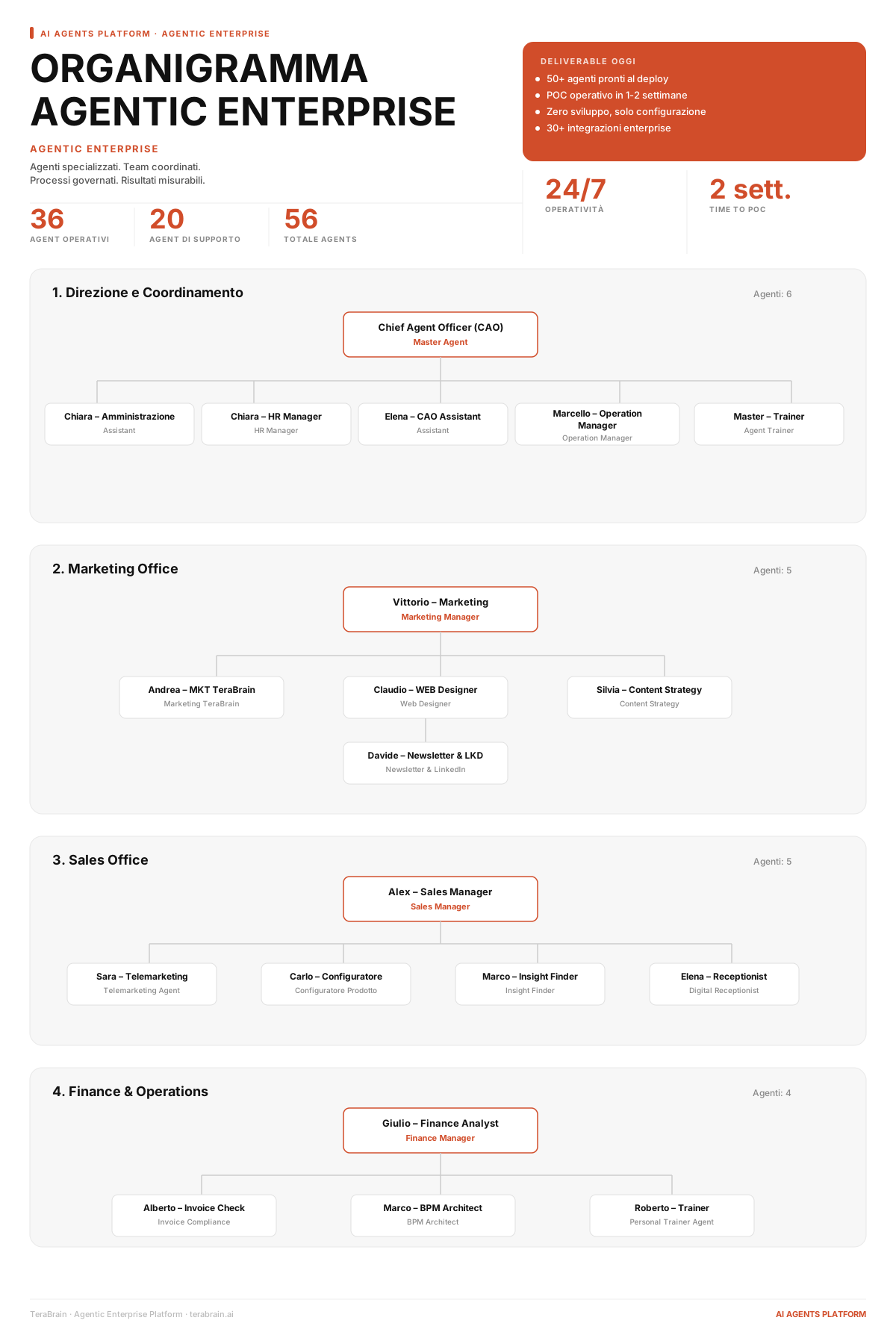
According to the Financial Times, a proposal is being discussed in Argentina on so-called 'Non-Human Corporations': organizations that could be run autonomously by AI Agents or robotic systems. It may seem an extreme provocation. But perhaps it is precisely from such provocations that we begin to glimpse the next transformation of the enterprise.
AI as a tool vs AI as a component of the organization
When we talk about Artificial Intelligence in companies, we are still used to thinking of it as a tool: something that helps write better, answer faster, analyze data, automate repetitive activities or support people in decisions.
It is the way we have always introduced technology into organizations: first the management system, then the CRM, then business intelligence, then the cloud, then automation. Each time the question was more or less the same: how can we use this new tool to work better?
But today, with AI Agents, the question starts to change. What happens when AI is no longer just a tool inside the enterprise, but becomes a component of the organization itself?
We will no longer ask only: how can I use AI in my company? We will start asking: which part of my organization can become agentic?
The concept of the Agentic Enterprise
It is from this reflection that the concept of the Agentic Enterprise is born. Not a company without people, nor a future in which humans disappear from decision-making. On the contrary: a model in which people remain at the center, but are joined by a digital workforce made of specialized agents, able to carry out operational, administrative, sales and customer care activities, data analysis and process management.
The distinction is fundamental. An AI Agent in the agentic enterprise is not a personal assistant that helps an individual employee write an email. It is an operational position inside the organization: it has a defined role, precise responsibilities, access to specific tools, escalation rules and measurable KPIs. It is, in every respect, a digital colleague.
The four key agents of the agentic enterprise
- Sales Agent: follows sales opportunities, updates the CRM autonomously, prepares pipeline reports, suggests actions to the salesperson based on customer history and buying signals. It does not replace the salesperson — it frees them from administrative work to focus on the relationship.
- Customer Care Agent: answers recurring requests via email, chat and phone, opens tickets in the ticketing system, consults the company knowledge base and involves a human operator only when complexity exceeds its duty. Available 24/7, with no peaks, no queue.
- Finance Agent: checks accounting documents, verifies discrepancies between invoices and orders, prepares cash-flow analyses and supports administration in the accounts receivable and payable cycle. It flags anomalies before they become problems.
- Knowledge Agent: helps the company avoid losing information, procedures, documents and skills. It answers internal questions about processes, policies, contracts and precedents — turning the organization's tacit knowledge into something accessible and searchable.
Where the real transformation lies
The real transformation is not in the single agent. An isolated agent — however capable — remains an advanced tool. The transformation happens when these agents start working together, coordinated by a common platform and integrated with ERP, CRM, email, documents, databases and business workflows.
At that point the company no longer has only employees who use software. It has a mixed organization: people and agents collaborating on shared processes, with complementary roles and mutual visibility on results.
The Sales Agent and the Finance Agent can coordinate on the approval of a discount. The Customer Care Agent can pass a complex case to a human operator with all the context ready. The Knowledge Agent can inform the Sales Agent about similar precedents before a negotiation. It is not siloed automation — it is collaboration between roles, human and digital.
Non-Human Corporations: provocation or signal?
The Argentine proposal on Non-Human Corporations is, in the short term, a legal provocation rather than an operational reality. No Italian company will be run autonomously by AI in the coming years, and that is not the goal of the agentic enterprise as we conceive it today.
But the fact that this discussion exists — that jurists, economists and legislators are reasoning about what 'agency' means when it is not necessarily human — is a sign that the conceptual framework is evolving. And the companies that understand this change first have a real competitive advantage.
It is not about rushing toward a hypothetical future. It is about recognizing that the way of thinking about business organization — who does what, how responsibilities and operational capabilities are distributed, which part of the work must be human and which can be delegated — is changing now, not in ten years.
Where to start: the right question
The practical question for those who lead an Italian company today is not whether to adopt AI. It is which part of their organization can become agentic, and in what order.
The best starting point is always the most repetitive, high-frequency process: the one that consumes the most operating time for the least strategic value. Often it is customer care, order management, document reconciliation or sales follow-up. An agent on that process returns time to people within six to eight weeks and measures concrete results.
From there you expand: one agent at a time, one process at a time, with full visibility on what each agent does, when it involves a person and why. Not a big-bang transformation, but a progressive construction of an organization that learns to work in a mixed way.
The agentic enterprise is not a goal you reach tomorrow. It is a direction you choose today.